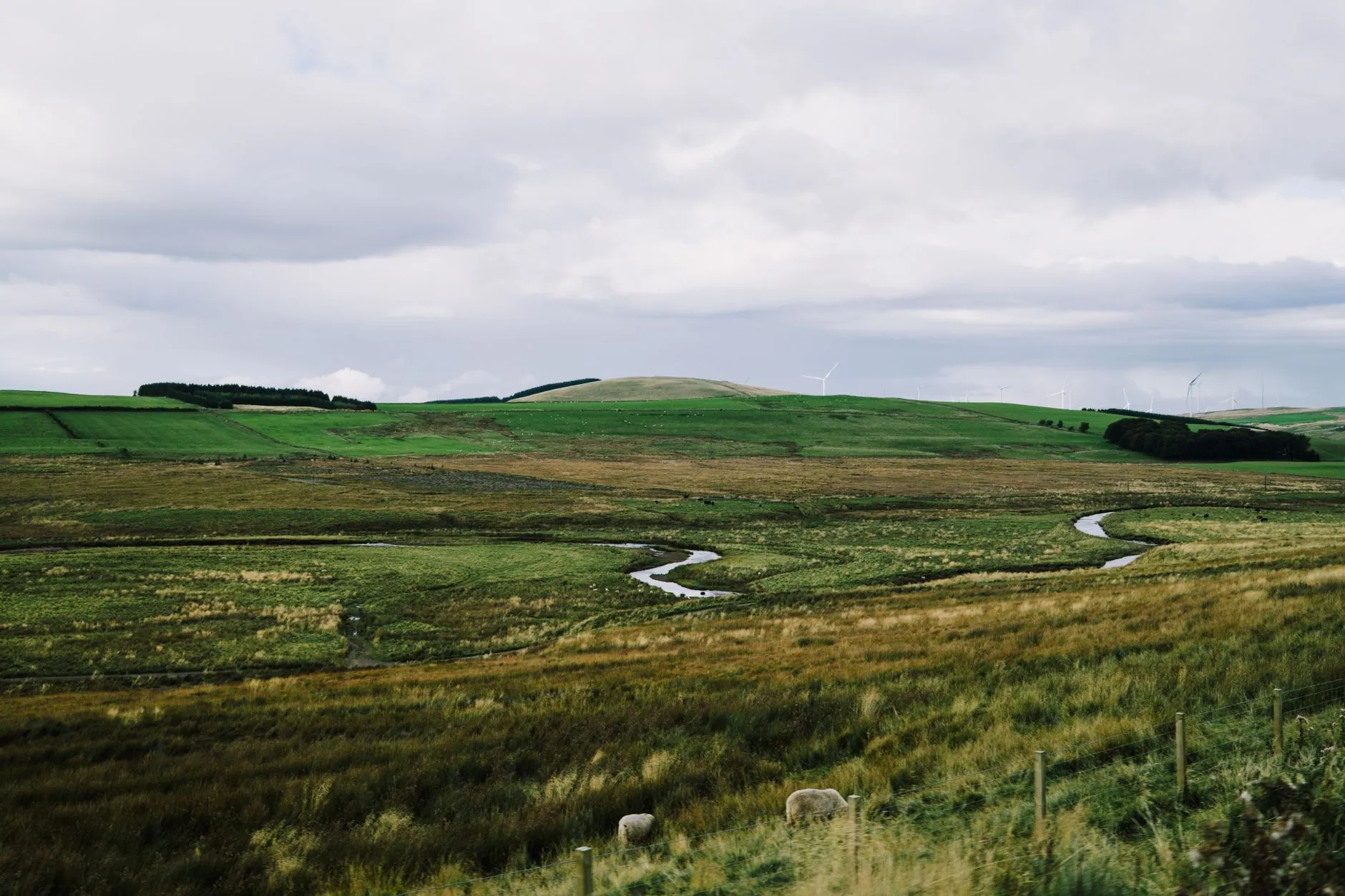
Buying a turbine for your own land follows five steps at any size: screen the site, settle the size, win planning consent, agree the grid connection, then choose a certified installer and turbine. Planning is the step to plan around. In England, the consultation the government opened on 18 March 2026 states that current permitted development rights do not extend to installing turbines on non-domestic premises.
Which business and farm sites suit a wind turbine?
The site matters more than the machine. A rotor needs wind that reaches it clean and unbroken, which usually means open farmland, a ridge or a coastal plot with space around the tower, not a yard boxed in by sheds, trees or neighbouring units. MCS, the UK's quality mark for small-scale renewables, advises a hilltop or raised position away from trees and other buildings. On a farm, the practical questions are where the tower can stand clear of the farmhouse and the neighbours, how a crane will reach the base and how far the cable must run to the meter.
Screen the site before asking for quotes: the guide to wind speeds by region shows how to look up a wind speed for your location, and the wind turbine output calculator turns a mean wind speed at hub height into a first estimate of a year's generation.
What size of turbine, and what changes at 50 kW?
MCS's product standard, as the government's 2026 consultation quotes it, defines a small wind turbine as one rated at up to 50 kW with a rotor swept area of no more than 200 square metres. Machines rated at 10 kW, 20 kW or 50 kW sit inside that definition; a 100 kW machine sits outside it. The turbine sizing guide works out which rating a site's demand calls for. Three things change at or near the 50 kW line:
- Export evidence. Above it the turbine is outside MCS's small-wind definition, so ask the export tariff provider what evidence of eligibility it will accept before you order.
- Grid. National Grid Electricity Distribution moves from a simplified application to its standard application form above 50 kW on a three-phase supply.
- Planning in England. The permitted development right proposed in 2026 would reach only a turbine up to 30 metres to the blade tip with no more than 200 square metres of rotor, which the consultation says allows up to 50 kW.
Do you need planning permission for a business wind turbine?
Expect to. None of the four nations' permitted development rules read for this page has a class for a turbine on business premises, so the route is an application to the local planning authority. As read on 24 November 2026:
| Nation | What the rules say about a turbine on business or farm land |
|---|---|
| England | Government says current permitted development rights do not extend to turbines on non-domestic premises, and the order's turbine classes (Part 14) cover domestic premises only. A right for one small non-domestic turbine was consulted on from 18 March to 10 June 2026; government aimed to respond in autumn 2026, and the consultation page still said it was analysing the feedback. |
| Scotland | The non-domestic part of the order (Part 1B) covers heat pumps, solar and buildings for biomass or anaerobic digestion plant, with no turbine class; the amending order in force from 24 May 2024 rewrote its heat pump and solar classes and added none for wind. Scottish Government guidance from 2021 says non-domestic scale microgeneration equipment will generally require planning permission. |
| Wales | Welsh Government guidance gives permitted development only for a stand-alone turbine within the boundaries of a dwellinghouse. Part 43 of the Welsh order, renamed in 2019 for non-domestic energy generation equipment, has classes for solar, heat pumps and biomass or CHP flues, and none for turbines. |
| Northern Ireland | Part 37 of the 2015 order, for non-domestic microgeneration, covers solar, heat pumps, a biomass or CHP boiler house and a biomass fuel store, with no turbine class. For the environmental side of an application, DAERA says a desk top water features survey will normally suffice for a single small-scale turbine. |
legislation.gov.uk showed no outstanding changes to any of these provisions on that date.
The English right is only a proposal. As consulted on, it would cover one standalone turbine per site, or its replacement, where no turbine already stands, with prior approval from the council on siting, local amenity and land contamination. On a farm, the proposed separation from neighbouring homes would not apply to the farm's own farmhouse.
Once an application is in, the clean energy chapter of the National Planning Policy Framework asks decision-makers to give substantial weight to the contribution small-scale and community-led renewable projects make to reducing emissions, says applicants should not be required to demonstrate the need for renewable energy, and judges a proposal outside the areas a development plan identifies as suitable against the Framework as a whole. Planning practice guidance on gov.uk, in a wind paragraph last revised in June 2015, still says an application should not be approved unless the site is in an area a Local or Neighbourhood Plan identifies as suitable, so ask the council at pre-application stage how it reads the two together.
How does a turbine connect to the grid?
A turbine running in parallel with the network goes through the network operator's connection process, which sets part of the timetable. Taking National Grid Electricity Distribution (NGED) as one example, its G99 procedures apply to generation rated above 16 A (3.68 kW) per phase, and its application route changes at 50 kW as described above. NGED wants compliance test records with the application where the equipment is not type tested, says the G99 commissioning tests are the installer's responsibility, and may witness them for a fee.
Other operators publish their own steps. SSEN, for example, must be notified at least 15 days before generation equipment above 50 kW is installed and commissioned, because its team attends the test.
MCS certification and export payments
MCS certifies both sides of the job: it says certified installers use MCS certified small wind turbines, and it suggests checking an installer on its Find an Installer search when you get a quote, before you sign and before installation starts. Its small wind installation standard, MIS 3003, was rewritten in December 2024, and the output estimate now sits in its own standard, MCS 033, which uses a Global Wind Atlas lookup or at least six months of on-site wind monitoring.
For export income in Great Britain, Ofgem lists wind as eligible for the Smart Export Guarantee (SEG) up to 5 MW. You can apply to any SEG licensee, not necessarily your electricity supplier; it sets the payment and contract length, and any tariff must stay above zero. MCS adds that you need a smart meter recording export and an installation by an MCS certified installer using certified products, and that the licensee may ask for the MCS certificate. Northern Ireland is outside the SEG, which Ofgem limits to Great Britain; the guide to selling exported power in Northern Ireland covers the arrangements there.
What should a turbine quote list?
MCS expects a certified installer's quote to be clear, to give a full breakdown of what you are buying and to name any subcontractors. Ask every wind turbine supplier or installer for the same lines:
- Wind data: its source, the height it describes and the yearly output it predicts.
- The turbine: model, rated power and the wind speed behind that rating, the power curve, tower height and, up to 50 kW, the MCS product certificate.
- Planning: the surveys and reports included, who submits the application, and what you pay if consent is refused.
- Grid: who applies to the network operator and by which route, who carries out the commissioning tests, and whether any witness fee is included.
- Works: foundations, crane access, cable route, protection equipment and the export meter.
- Handover and service: the handover pack, which MCS says includes a recommended servicing and maintenance schedule and the warranty documents, plus the service plan's price and scope.
Compare quotes as a cost per kWh, not a headline price: the commercial wind turbine cost guide shows the method, and the wind turbine lifespan and maintenance guide covers servicing, insurance and removal at the end of a turbine's life. Once a site has passed the screen, you can send its details through the quote request form.
Sources
All checked 24 November 2026; the official page is the authority if it differs from this one.
- DESNZ: Permitted development rights for onshore wind turbines in England (closed consultation, 18 March to 10 June 2026) and its consultation document.
- MHCLG: National Planning Policy Framework, chapter 10 (29 September 2026); Renewable and low carbon energy planning practice guidance (14 August 2023).
- legislation.gov.uk: permitted development orders for England (Part 14), Scotland (Part 1B) and its 2024 amending order, Wales (Schedule 2) and Northern Ireland (Part 37).
- Scottish Government: householder permitted development guidance (1 April 2021); Welsh Government: Planning permission: wind turbines; DAERA: Wind energy installations.
- NGED: G99 connection procedures; SSEN: Generation connection at or above 50kW; Ofgem: Smart Export Guarantee: generators.
- MCS: Small wind turbines, Smart Export Guarantee and updates to small wind turbine Standards (6 December 2024).
Request a commercial wind turbine quote
Commercial Wind Turbines: common questions
Does a farm wind turbine need planning permission in Scotland, Wales or Northern Ireland?
Plan on it. Scotland's permitted development rules for non-domestic buildings have no turbine class, and Scottish Government guidance says non-domestic scale microgeneration equipment will generally require planning permission. The Welsh and Northern Irish orders list solar, heat pump and flue or boiler house classes for non-domestic premises but no turbine class, so an application to the local planning authority is the route.
Does the SEG licensee have to be the business's electricity supplier?
No. Ofgem says you can apply for a SEG tariff with any SEG licensee, and it does not need to be the company that supplies your electricity. Each licensee sets its own payment and contract length, so compare offers before signing.
What does MCS certification cover for a small wind turbine?
Both the installer and the turbine: MCS says certified installers use MCS certified small wind turbines, and its small-wind definition runs to 50 kW of rated output and 200 square metres of rotor. Check the installer on MCS's Find an Installer search when you get a quote, before you sign and before work starts.
What should a turbine's handover pack contain?
MCS says a certified installer provides a handover pack on completion, including a list of the system's key parts, health and safety guidance, a recommended servicing and maintenance schedule, the manufacturer's manuals and the relevant warranty documents. Keep it with the planning consent and the connection paperwork, because an insurer or a buyer of the site may ask to see them.
Renewable energy guides by city
Local guides to renewable energy for businesses in each city:
London · Birmingham · Leeds · Sheffield · Manchester · Bradford · Liverpool · Bristol · Coventry · Cardiff · Leicester · Nottingham · Doncaster · Newcastle upon Tyne · Milton Keynes · Sunderland · Southampton · Hull · Wolverhampton · Plymouth · Derby · Stoke-on-Trent · Northampton · Swindon · Luton · Portsmouth · Reading · Oxford · Cambridge · Norwich · Castleford · South Wales · Stokesley · Northamptonshire · Wellingborough · Yorkshire and the Humber · East Midlands · East of England · North East · North West · Northern Ireland · Scotland · South East · South West · West Midlands