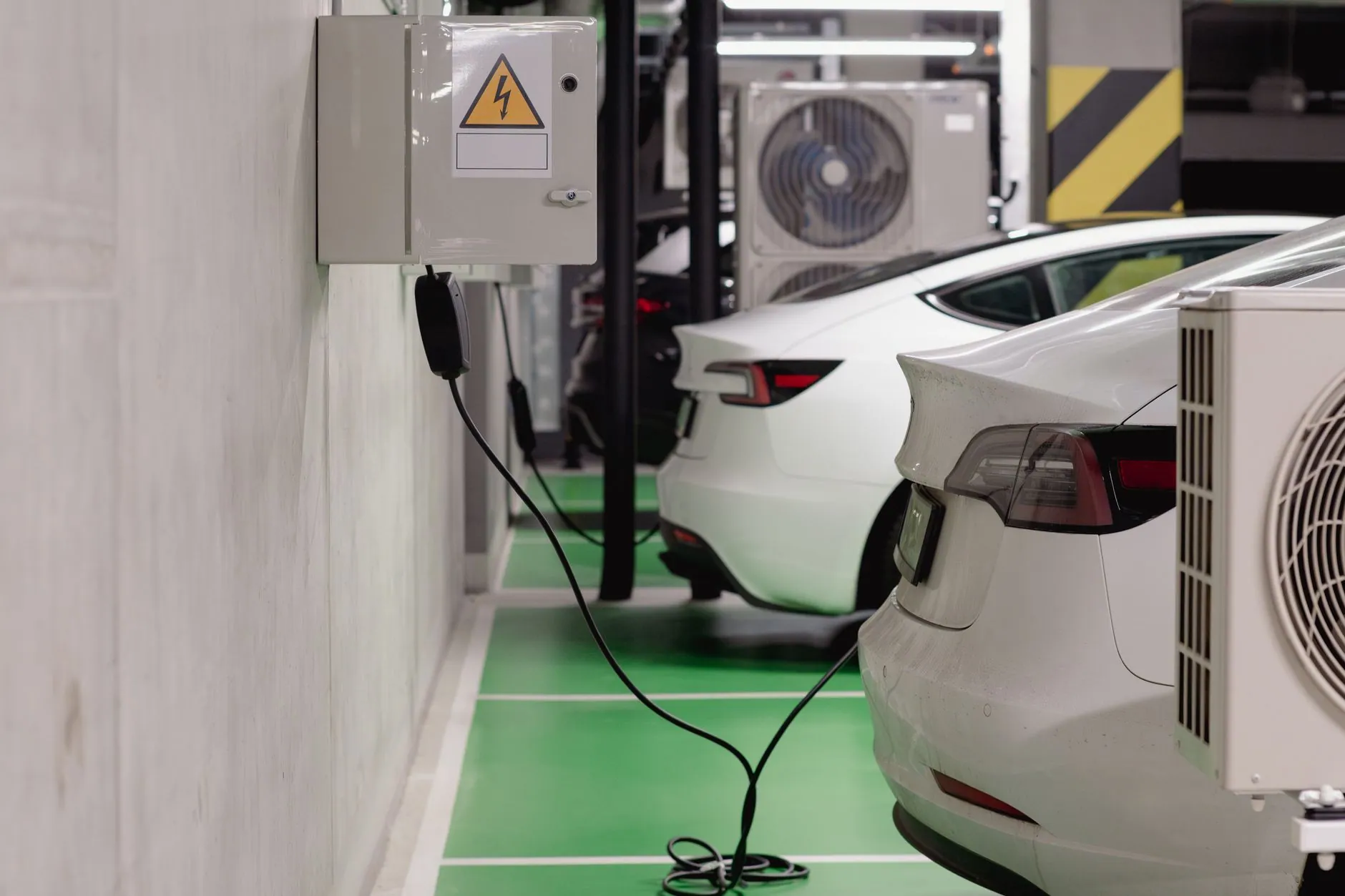
Typical EV charging project
- Typical scale
- 7 kW - 350 kW chargers
- Project value
- £3,000 - £150,000+
- Typical payback
- 5 years
- Annual CO₂ saved
- 5-200 (fleet fuel switch) tonnes
Commercial EV charging for UK business
Commercial EV charging means installing chargepoints at your premises for staff, visitors and fleet vehicles, then running and, where you choose, billing them. It spans three distinct jobs: workplace charging so employees top up while they work, customer-facing charging that keeps visitors on site or earns paid revenue, and fleet or depot charging that fuels your own vans, cars and HGVs overnight. For most UK businesses it is worth doing, because the alternative is buying transport fuel at grid rates of 25 to 45p per kWh, or forecourt diesel and petrol, when self-generated solar can charge a vehicle for a few pence. Grants and tax relief cut the install cost, and payback often lands in three to six years.
It is also increasingly not optional. Part S of the Building Regulations now mandates EV charging provision in many new and substantially renovated commercial buildings, larger customers ask about your fleet decarbonisation in tenders, and the shift to electric vans and cars is already under way across UK business. The question for most sites is no longer whether to install charging, but how many chargepoints, at what power, funded how, and whether they run on grid power or your own generation.
Why it matters for your business
Transport is often the largest slice of a business’s Scope 1 carbon, and fuel is a volatile, rising cost. Electrifying the fleet and charging on site addresses both at once. A van that costs 12 to 15p a mile on diesel can run on 3 to 5p a mile charged on cheap overnight or self-generated power. Workplace charging is also a low-cost staff benefit that supports recruitment and retention, and customer-facing chargers keep visitors on site longer at retail, hospitality and leisure venues. Done well, commercial EV charging is a revenue and cost lever, not just a compliance box.
How commercial EV charging works
An EV chargepoint delivers electricity to a vehicle in one of two ways. AC charging, from around 7kW to 22kW, is the workhorse of workplace and destination charging: the vehicle’s onboard charger converts the power, and a car adds enough range over a working day or an overnight shift. DC rapid charging, from 50kW up to 350kW, converts the power in the unit itself and delivers a large charge in 20 to 60 minutes, suited to public-facing hubs and fleets that turn vehicles around fast.
Hardware from 7kW posts to 350kW hubs
The right hardware follows the dwell time of the vehicle, not the biggest number on the spec sheet. Staff and visitors who park for hours are well served by 7kW to 22kW AC posts, which are far cheaper to buy and install and put less strain on your supply. A logistics depot charging vans overnight also usually wants AC, sized so the whole fleet is full by the morning shift. Only forecourt-style public charging and fast fleet turnaround justify 50kW to 350kW DC rapid units, which cost more and often need serious grid works. We size the mix from how long each vehicle actually sits, so you are not paying for rapid chargers that stand idle.
Back-office billing and access control
Modern chargepoints speak OCPP, the open protocol that lets any compliant charger talk to any compliant back-office platform. That back office is what turns hardware into a managed asset: it authenticates users, meters energy per driver or vehicle, and bills accordingly. You can offer staff charging free or at cost, reimburse fleet drivers accurately, restrict visitor access to authorised users, or run paid public charging with card or app payment. OCPP compliance also means you are not locked into one supplier’s software for the life of the installation, which matters over a 10-year asset.
Sizing and economics
A commercial EV charging project ranges from around £3,000 for a couple of 7kW workplace posts to £150,000 or more for a rapid DC hub, with most sites landing somewhere between depending on charge-point count and how much cabling, groundworks and grid capacity the site needs. A typical installation is 2 to 50 or more charge points. The bulk of the cost is rarely the chargers themselves; it is the civil works, cable runs across a car park or depot, and any supply reinforcement. Payback on fleet charging often falls in the three to six year range once fuel savings, grants and tax relief are counted, and workplace or paid public charging can pay back faster where usage is high.
Charging on your own power changes the numbers
The single biggest economic lever is where the electricity comes from. Charging on grid power at 25 to 45p per kWh is far cheaper than forecourt fuel, but charging on self-generated solar at a few pence per kWh is transformative. A fleet that charges through the day on rooftop solar, or overnight on stored solar and cheap off-peak grid, runs at a fraction of the cost of either fuel or standard grid charging. This is why we rarely design charging in isolation: paired with commercial solar and battery storage, a charging installation stops being a cost centre and becomes the point at which cheap self-generated power is put to work. Add smart tariffs and load management, and the effective cost per mile falls again.
A representative fleet-charging project
For a modelled example, a logistics operator running an electric van fleet from a distribution unit installs a dozen 22kW AC chargers alongside rooftop solar and a battery. The vans charge on self-generated and stored power on early shifts, load management spreads demand so no supply upgrade is needed, and the Workplace Charging Scheme part-funds the sockets. The result is fleet fuel switched from forecourt and grid rates to a few pence per kWh, with a credible renewable disclosure for customer tenders. Figures on any real site come from your own meter data and fleet profile, modelled before you commit.
Funding and grants for EV charging
EV charging is one of the better-supported renewable measures for business, because a dedicated grant sits on top of the general tax reliefs.
Workplace Charging Scheme
The Workplace Charging Scheme (WCS) gives a voucher worth £500 per charging socket, up to a maximum of 40 sockets, for businesses, charities and public bodies installing chargepoints for staff and fleet use. Crucially, the scheme requires the chargepoints and the installing company to be OZEV-approved, which is a core reason to use a certified specialist rather than a general electrician.
Tax relief on owned chargepoints
Owned EV chargepoints qualify as plant and machinery, so they attract 100% Annual Investment Allowance: a profitable company deducts the full cost from taxable profit in year one and recovers roughly a quarter of it through tax. VAT is separately reclaimable for VAT-registered businesses. Combined with the WCS, the effective net cost of a workplace charging installation is well below the headline price. We set out the grant eligibility, tax treatment and net cost in the proposal, and you can see the full picture on our grants and funding and cost pages.
Compliance and grid connection
EV charging carries its own regulatory framework, and getting it right at design stage avoids expensive surprises later.
OZEV approval, smart charging and Part S
For any grant-funded installation, both the chargepoints and the installer must be OZEV-approved, so approval is a prerequisite, not a nice-to-have. The Electric Vehicles (Smart Charge Points) Regulations 2021 make smart-charging functionality mandatory on new chargepoints, so units can respond to signals and shift charging away from peak demand. Part S of the Building Regulations mandates EV charging provision in many new and renovated commercial buildings, which means new projects should design in capacity from the outset. We install OZEV-approved, OCPP-compliant, smart-charging-compliant hardware as standard, so grant eligibility and regulatory compliance are covered.
Grid capacity and load management
The largest risk to an EV charging budget is the grid connection. Larger loads need notification to or approval from your Distribution Network Operator, and a bank of rapid chargers can easily exceed your existing supply. The traditional answer, a supply upgrade, can cost tens of thousands of pounds and take months. The better answer is usually load management: dynamic load balancing spreads the available power across chargers and around the rest of the site’s demand, so the fleet still charges overnight without drawing more than your supply can give. This frequently avoids the DNO upgrade entirely, or defers it until genuinely needed. We assess your existing capacity from half-hourly meter data before specifying anything, so grid works are only proposed where they are unavoidable.
When EV charging does and does not suit a business
We are technology-neutral, so we will tell you honestly where charging earns its keep and where it does not, yet.
It suits you well if you run or are moving to an electric fleet, if staff or visitors dwell on site long enough to charge, if you have or plan on-site solar to feed the chargers, or if Part S or a customer tender requires provision. Depots, offices with staff parking, retail and hospitality venues, and any fleet operator are natural fits, especially where a roof or car park can host solar to power the charging.
It is worth pausing where the case is weaker. If your fleet is not yet electrifying and there is no staff or visitor demand, chargers can stand idle and the capital is better spent on efficiency or solar first. If a rapid DC hub would force a large, expensive grid upgrade that the usage cannot justify, slower AC charging with load management is usually the smarter first step. And a handful of public rapid chargers is a genuine business in its own right, with different economics from workplace charging, so it should be modelled on realistic utilisation, not optimistic assumptions. An honest assessment sometimes concludes that charging should follow solar and efficiency in the sequence, rather than lead.
How EV charging fits the wider renewable stack
Charging is at its strongest as part of an integrated system, not a standalone install. On its own it simply moves your fuel bill from the forecourt to the grid meter, which is still a saving but not the full prize. The full prize comes from combining it with the technologies that make the electricity cheap and clean.
Paired with commercial solar, the fleet charges on power generated on your own roof or car park at a few pence per kWh. Add battery storage and the surplus solar generated during the day is stored to charge vehicles in the evening and overnight, lifting self-consumption and avoiding peak grid prices. Energy management and load balancing tie it together, spreading demand so you avoid a grid upgrade and see exactly what each vehicle costs to charge. For sites also electrifying heat, heat pumps share the same self-generated power and the same integrated design. And where capital is the barrier, a PPA or procurement route can fund the generation that powers the chargers at zero upfront cost. Designed together, these measures compound: each one makes the others cheaper to run.
How we work
We start with your meter data, fleet profile and site layout, then model the right number and type of chargepoints, the grid capacity you actually have, and whether load management can avoid a supply upgrade. We check grant eligibility, size any solar and battery that should feed the chargers, and set out the net cost after the WCS and tax relief. Every proposal is fixed-price, the hardware is OZEV-approved and OCPP-compliant, and we will tell you plainly if charging should wait behind solar or efficiency in your sequence. If you have questions first, our FAQs cover the common ones. When you are ready, request a free assessment and quote and we will build you a costed charging plan you can take to the board.
Get a free EV charging assessment
EV Charging: common questions
How much does commercial EV charging cost to install?
A couple of 7kW workplace posts start around £3,000, while a large rapid DC hub with grid works can exceed £150,000. Most of the cost sits in cabling, groundworks and any supply upgrade rather than the chargers themselves. The Workplace Charging Scheme gives £500 per socket, up to 40 sockets, cutting the net figure.
What grants are available for workplace and fleet EV charging?
Two main schemes. The Workplace Charging Scheme (WCS) gives £500 per socket, up to 40 sockets, for staff and fleet charging. Both require OZEV-approved hardware and an OZEV-approved installer. Owned chargepoints also qualify for 100% Annual Investment Allowance.
Do I need a grid connection upgrade for EV chargers?
Not always. Larger loads need a DNO notification or approval, and a rapid hub can exceed your existing supply. Load balancing and dynamic load management spread the available power across chargers and around your site's demand, which frequently avoids a costly supply upgrade. We assess your capacity from your meter data first, so you only pay for grid works you genuinely need.
Can I charge my fleet on solar power?
Yes, and it transforms the economics. On-site solar generates power at a few pence per kWh through the working day, a battery stores the surplus, and smart charging draws on that stored solar. Charging a fleet or staff cars this way instead of grid power at 25-45p or forecourt fuel cuts both cost and Scope 1 and 2 carbon. We design solar, battery and charging as one integrated system with load management.