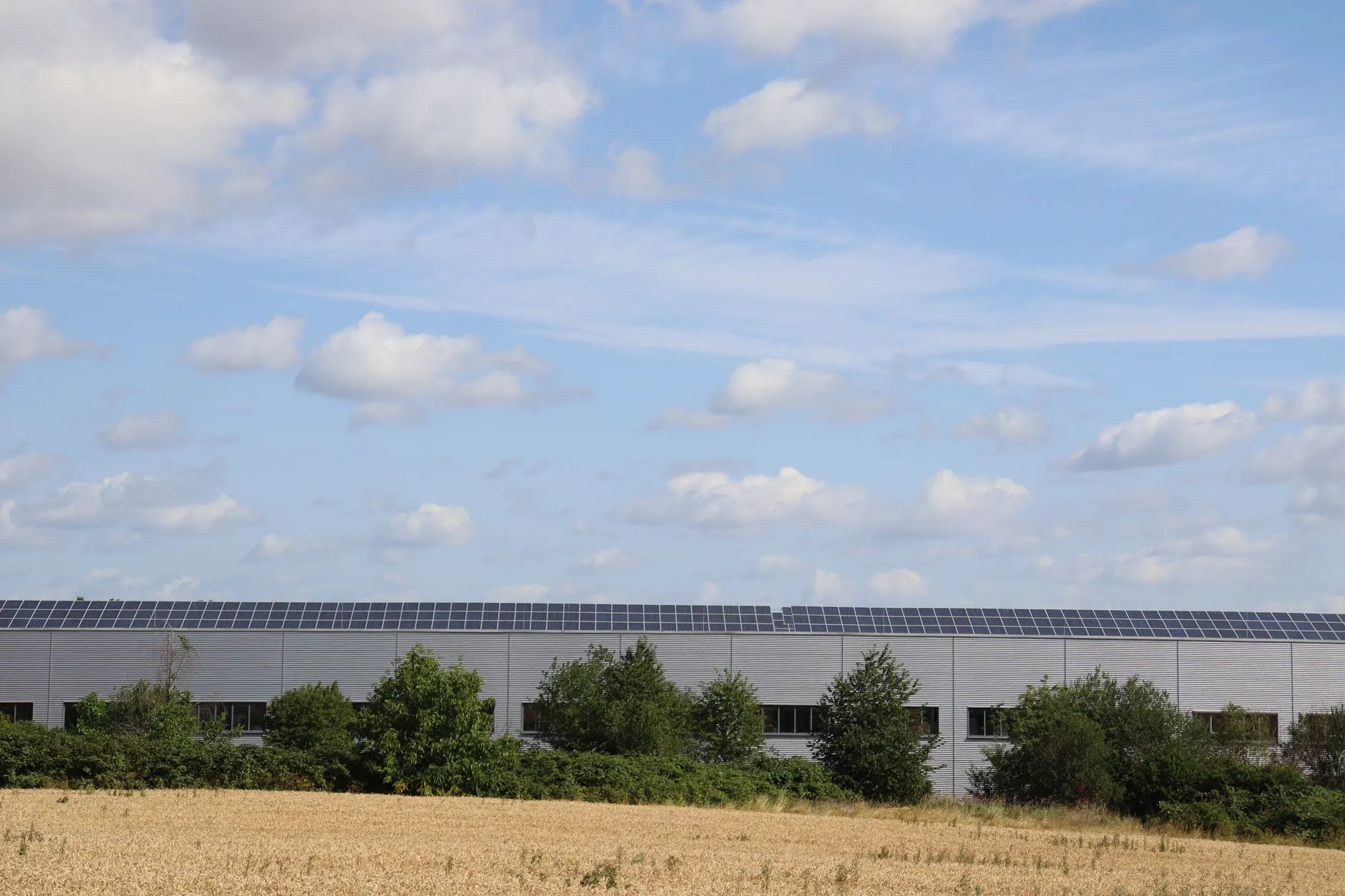
Typical commercial solar pv project
- Typical scale
- 30 kW - 2 MW
- Project value
- £25,000 - £1.5m
- Typical payback
- 6 years
- Annual generation
- 27,000 - 1,840,000 kWh
- Annual CO₂ saved
- 6-420 tonnes
What commercial solar PV is and why it matters for your business
Commercial solar panels convert daylight into electricity that your business uses directly, offsetting the power you would otherwise buy from the grid at 25 to 45p per kWh. For most UK businesses with a reasonable roof, solar is the single biggest lever on their energy bill and the cornerstone of any credible renewable strategy. It is low-risk, needs little space beyond a roof you already own, and generates most strongly during the working day when your demand is highest. That alignment between generation and consumption is what makes solar panels for business pay, and it is why we recommend it as the first capital measure for the majority of sites.
The economics are proven and bankable. A well-designed commercial solar PV system pays for itself in 5 to 8 years, then delivers 15 to 20 more years of near-free electricity under a 25-year performance warranty. Along the way it cuts your Scope 2 carbon emissions directly, which matters more every year as customers, investors and lenders ask what your business is doing about its energy and carbon. Solar alone will not touch your gas or fleet-fuel emissions, and we are honest about that, but as the foundation of a wider stack that later adds battery storage, EV charging and heat pumps, it is where almost every business should start.
We are independent and technology-neutral. We do not sell one box. We assess whether solar genuinely suits your building and load profile, size it from your actual meter data, and tell you plainly when a roof or a site does not stack up.
How a commercial solar PV system works
A commercial solar installation has four core parts, and understanding them helps you judge a proposal.
Panels
The panels themselves are the generating layer. Modern commercial panels are mono-crystalline silicon, mounted in an array sized to your roof and consumption. In the UK, one kilowatt-peak (kWp) of panels needs roughly 5 to 6 square metres of roof and yields around 900 to 1,050 kWh a year, even accounting for our diffuse, cloudy light. Panels carry a 25-year output warranty and degrade only slowly, so a system installed today is still producing over 85% of its original output two decades later.
Inverters
Panels generate direct current; your building and the grid run on alternating current. Inverters do the conversion. On larger commercial roofs we typically use string inverters, sometimes with optimisers where shading is a factor. The inverter is the working heart of the system and the component most likely to need replacement once across the panels’ lifetime, which we build into the whole-life costing rather than hiding it.
Mounting
Mounting secures the array to the roof. Steel-portal warehouse and factory roofs are the best canvas in commercial solar: large, unshaded, and structurally straightforward to fix to. Flat roofs use ballasted or penetrative mounting; pitched profile roofs use clamp systems. Where the roof is not suitable, ground-mount frames or a solar carport over a car park deliver the same generation on a different footprint.
Metering and monitoring
A generation meter records what the array produces, and export metering records any surplus sent back to the grid. Real-time monitoring lets you and us see performance live, prove the savings for your reporting, and catch any fault early. This data also feeds directly into SECR and ESG disclosures.
Sizing and economics: the numbers that decide the return
The single most important design decision is size, and it is not set by your roof area. We size every system from your half-hourly meter data and model it in PVSyst, targeting a system that covers 60 to 85% of your annual consumption. Oversize it and you export cheap surplus for a few pence; undersize it and you leave savings on the table.
Self-consumption is what makes the return
The figure that decides your payback is self-consumption: the share of generated power you use on site rather than export. Most commercial sites achieve 55 to 85% self-consumption, and the higher that number, the faster the payback, because every self-consumed unit is worth the 25 to 45p you did not pay the grid, while an exported unit is worth only the Smart Export Guarantee rate. A business that operates through daylight hours, a warehouse, a factory, an office, naturally self-consumes well. This is why we model your load shape before quoting a size, not after.
What it costs
Commercial solar costs roughly £600 to £1,300 per kWp installed, with the per-unit price falling as systems get larger. In practical terms:
- A 50kW office array runs around £45,000 to £60,000
- A 250kW warehouse system runs around £190,000 to £240,000
- A 1MW factory install runs around £600,000 to £750,000
Across the full range, a typical commercial solar PV project sits between £25,000 and £1.5m depending on scale, generating anywhere from 27,000 to over 1,800,000 kWh a year and saving 6 to 420 tonnes of CO2 annually.
Payback and lifetime value
Payback typically lands at 5 to 8 years. After that, the system produces for another 15 to 20 years at near-zero running cost, all under a 25-year warranty. Over the life of the array, that is two decades of electricity at a fraction of grid prices, which is why solar is usually the strongest capital project on a commercial site’s table.
Funding and grants specific to solar
The headline cost is not the net cost. Several genuine UK routes bring it down.
100% Annual Investment Allowance. Solar PV qualifies as plant and machinery, so a profitable company can deduct the full capital cost from its taxable profit, recovering roughly a quarter of the outlay through corporation tax relief. Solar is special-rate plant, so it does not qualify for Full Expensing; above the £1m AIA cap the balance attracts the 50% first-year allowance instead. This is the primary lever on owned solar.
VAT reclaim. VAT-registered businesses reclaim the VAT on the installation in the normal way, so the effective cost falls further.
Smart Export Guarantee (SEG). MCS-certified systems earn a payment, typically 4 to 15p per kWh, for surplus power exported to the grid. This matters most for sites that export at weekends or overnight, such as offices, retail and schools. A competitive SEG tariff improves the whole business case.
For a full picture of how these stack for your project, see our grants and funding page and our indicative cost breakdown. Where capital is a barrier, an on-site power purchase agreement can deliver solar at zero capex, with a funder owning the panels and you simply buying the power below grid price.
Compliance and grid connection
Commercial solar is well-established territory, and the compliance is routine when handled by a certified specialist.
Planning. Most rooftop solar is Permitted Development under Class J of Part 14 of the GPDO 2015, so no planning application is required. Listed buildings, conservation-area sites and ground-mount arrays above certain thresholds are the exceptions and do need consent.
Grid connection. Every system needs a connection agreement with your Distribution Network Operator. Smaller systems use the G98 fast-track; most commercial installs need a full G99 application. Where the local network is constrained, G100 export limiting caps how much you send back, which often secures a connection quickly and avoids expensive grid reinforcement. Timescales run from a few weeks for small connections to several months for large ones, so we submit applications early.
Structural and asbestos. Any roof over roughly 1,000 square metres gets a structural survey to confirm it can carry the array. Roofs built before 2000 get an asbestos check, because much older commercial roofing is asbestos cement and must not be drilled. These are standard pre-installation steps, not obstacles.
Certification. Commercial solar work should be MCS-certified and covered by an insurance-backed workmanship warranty, which is also what makes a system eligible for the Smart Export Guarantee.
When commercial solar suits your business, and when it does not
We would rather tell you the truth up front than sell you a system that underperforms.
Solar suits your business well when you have a large, unshaded, structurally sound roof, ground for a mounted array, or a car park for a carport; when your demand falls in daylight hours so you self-consume most of what you generate; and when you own the building or have a long enough lease, or landlord agreement, to see the payback through.
Solar is a weaker fit when your roof is heavily shaded, north-facing, structurally marginal, or close to the end of its own service life, in which case a re-roof should come first. It is also a weaker fit if your consumption is almost entirely overnight, because you would export most of the generation at a low rate rather than self-consuming it, though a battery can partly solve that. And if you are about to move premises with no way to relocate or transfer the system, the economics need a harder look. In each of these cases we will say so, and point you to the measure that does pay on your site.
How solar fits the wider renewable stack
Solar is the foundation, but its return improves when it is designed as part of a whole. It pairs naturally with the other technologies we deliver:
- Battery storage stores daytime surplus for evening, weekend and overnight use, lifting self-consumption from 55-75% up to 80-95% and shaving expensive peak-demand charges. Most of our solar systems are designed battery-ready so storage can be added once you have a year of data.
- EV charging run on self-generated solar lets you charge a fleet or staff cars at a few pence per kWh instead of grid power at 25-45p, transforming the economics of electrifying transport.
- Commercial heat pumps are strongest when run on your own solar generation, and they remove the Scope 1 gas emissions that solar alone cannot touch.
- Energy management comes first in the ideal order: cutting waste means the solar array is sized to a lower, well-managed demand, so it pays back faster.
Designing these as one integrated system, rather than three or four separate installs, is what separates a bankable roadmap from a set of product sales. For a deeper technical treatment of rooftop and ground-mount commercial arrays, our sister specialists at commercialsolarpv.uk go into the design detail in full.
How we work
We start with your data, not a sales pitch. We pull your half-hourly meter readings, look at your roof, land and load profile, and model the right system size in PVSyst before we quote. You get a fixed-price proposal with the generation, self-consumption, saving, payback and CO2 figures laid out, and the funding options, cash purchase, asset finance or a zero-capex PPA, modelled side by side so your board can decide on merit. The work should be MCS-certified and insurance-backed, with the grid application, structural survey and any planning handled as part of the job. If solar is not the right first move for your site, we will tell you. Start with a free, no-obligation assessment: request a quote and we will build you the numbers.
Get a free commercial solar pv assessment
Commercial Solar PV: common questions
How much do commercial solar panels cost?
As a rule of thumb, roughly £600-£1,300 per kWp installed, falling per unit as the system gets larger. A 50kW office array is around £45,000-£60,000, a 250kW warehouse system £190,000-£240,000, and a 1MW factory install £600,000-£750,000. After 100% Annual Investment Allowance and VAT reclaim, the effective net cost to a profitable, VAT-registered business is significantly lower than the headline.
How long do commercial solar panels take to pay back?
Typically 5-8 years, driven mainly by how much of the generation you use on site rather than export. A business that consumes 55-85% of what it generates through the working day pays back fastest. After that, the panels keep producing for 15-20 more years at near-zero running cost, all under a 25-year performance warranty.
Will solar panels damage or overload my roof?
Not when the system is designed properly. Any roof over roughly 1,000 sqm gets a structural survey before we quote, and pre-2000 roofs get an asbestos check, because you must not drill into asbestos cement sheeting. Steel-portal warehouse and factory roofs are usually the ideal canvas. If a roof cannot safely carry the load, we say so and look at ground-mount or a solar carport instead.
Do I need planning permission for commercial solar panels?
Most rooftop solar is Permitted Development under Class J of Part 14 of the GPDO, so no planning application is needed. Listed buildings, conservation areas and larger ground-mount arrays are the main exceptions and do need consent. Every commercial system needs a G98 or G99 grid connection agreement with your DNO, which we handle as part of the install.