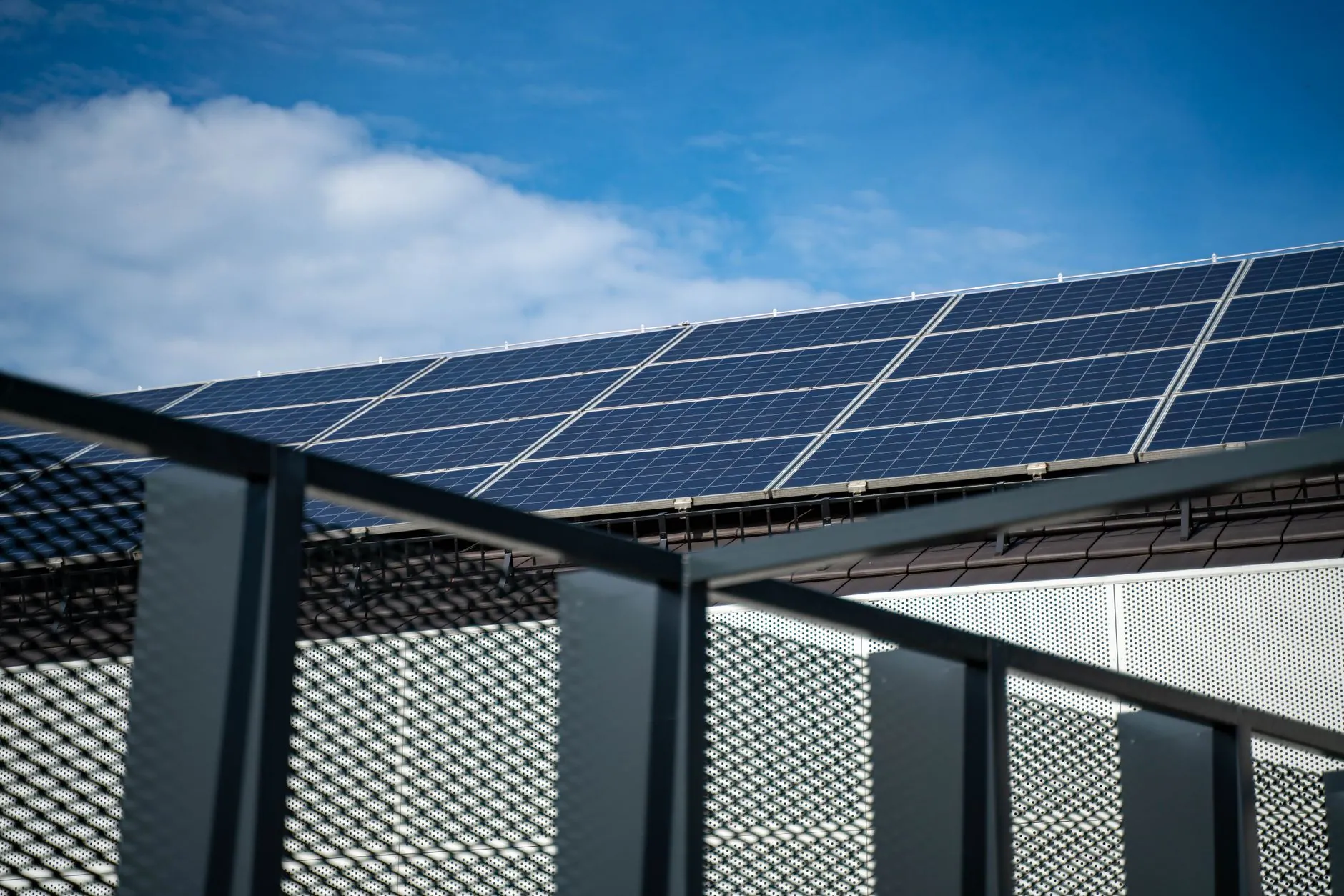
Typical commercial building renewable energy project
- Typical scale
- 30 kW - 2 MW
- Project value
- £25,000 - £1.5m
- Typical payback
- around 6 years
- Annual CO₂ saved
- 6 - 380 tonnes
The building decides the answer, not the sector
Two businesses on the same high street can get opposite advice on the same technology, and the reason is almost always physical. A retail unit sitting under a 900 m² single-storey roof has room for many times the array a three-storey office of the same floor area can carry, because the office stacks its consumption over a footprint the size of one floor plate. Sector is a weak predictor. Roof area per unit of consumption is a strong one.
This page covers four building types that behave differently: offices, from a single suite above a shop to a whole block; retail units, from an in-town shop to an out-of-town store with parking; mixed-use buildings with commercial ground floors and residential above; and light industrial units, the shallow-pitch steel sheds on trading estates. Each brings its own combination of roof structure, occupancy hours, plant space and metering arrangement.
Three physical questions settle most of it. What can the roof carry, and for how much longer will the covering last. When does the building actually draw power, measured against when a UK array actually generates. What headroom is left in the incoming supply, the distribution board and the plant space. Answer those three and the technology choice becomes close to obvious. Skip them and you get a quote that is really a guess.
What a survey has to settle before anyone prices the job
The survey runs as a sequence, and each step can stop the next. It starts at a desk with roof geometry, orientation and shading from lift overruns, parapets, plant or neighbouring buildings, then moves to the structure.
Structural capacity is the most common reason a scheme changes shape. The MCS solar PV installation standard requires the roof structure to be checked by a suitably competent person before installation, and on a flat roof ballasted array a structural engineer has to be consulted on the imposed load of both the array and its ballast. That standard covers installations up to 50 kWp DC. Above 50 kWp the array falls outside MCS scope and is governed directly by Building Regulations and the structural Eurocodes, principally BS EN 1991-1-4 for wind actions with the UK National Annex and BS EN 1991-1-3 for snow.
The covering is the next gate. A ballasted system spreads load through trays and blocks with no penetrations, which is usually the right call on single ply, felt or GRP, where a fixing is hard to seal reliably and can compromise the covering warranty. Remaining membrane life matters more than most people expect: panels carry a 25 year performance warranty, so putting them on a covering with six years left buys you a strip and refit later.
On older buildings, asbestos is a hard stop rather than a complication. The duty to manage under the Control of Asbestos Regulations 2012 applies to shops, offices and industrial units, and asbestos cement roof sheets must not be drilled, cut or walked on. HSE treats careful removal of intact sheets as non-licensed work, while breaking a roof up creates notifiable non-licensed work. On an asbestos cement shed the sensible route is to overclad, then mount on the new sheeting.
Insurers have their own view. RC62, the joint code of practice on fire safety with PV panel installations, was updated in February 2023 by RISCAuthority, MCS and Solar Energy UK and published by the Fire Protection Association, and it is aimed squarely at commercial and industrial rooftop systems. Telling your insurer at design stage is cheaper than discovering their requirements after commissioning.
The last steps are electrical and behavioural: incoming supply capacity, spare ways in the board, the network operator route, and half-hourly meter data covering a full twelve months so the design is matched to a real load shape rather than an annual total. Anything above 16 A per phase, which is 3.68 kW single phase or roughly 11 kW across three phases, needs a G99 application rather than the simpler G98 connect and notify route, and export limitation under G100 is often the fastest way to get a large array accepted where the network is tight.
Generation curve against occupancy curve
A UK array generates on a curve fixed by latitude and weather. The building's demand curve is fixed by what the business does. Value comes from where the two overlap, and that overlap differs sharply by building type.
Offices are the cleanest weekday match. Lighting, small power, servers and cooling run from roughly eight to six, sitting neatly under the generation curve, and cooling load rises on exactly the days the array performs best. The weakness is the weekend, when two days in seven of output meets a near-empty building.
Retail units carry the opposite risk. Trading is seven days, hours run into the evening, and the busiest trading month is December, when a UK array on a flat or shallow-pitch commercial roof produces roughly a sixth of what it makes in its strongest month. Refrigeration in food retail rescues this, because it runs a substantial round-the-clock base load that absorbs midday output all year.
Light industrial units usually score best. A single day shift with compressors, extraction, refrigeration or process load produces a flat weekday demand block under the generation curve, which is why self-consumption at the top of the 55 to 85 per cent band is realistic on a shed and optimistic on a weekday-only office.
The arithmetic that follows is simple. A self-consumed unit is worth the 25 to 45 pence you are not paying to import. An exported unit is worth 4 to 15 pence under the Smart Export Guarantee. Self-consumption is therefore worth several times export, around five times on mid-range numbers and more than ten times where import is high and the export tariff is poor, which is why battery storage moves the numbers so far: it lifts self-consumption from the 55 to 85 per cent band into 80 to 95 per cent by shifting midday surplus into evening and weekend hours.
Usable roof area, sizing and three worked cases
Usable roof is always well below gross roof once you allow for edge zones, rooflights, plant, walkways and access. Installed cost runs £600 to £1,300 per kWp, with the low end on large simple sheds and the high end on small constrained roofs. The three cases below are modelled scenarios built from the bands on this page, not real projects.
Modelled scenario one, a 900 m² single-storey retail unit. After edge zones, rooflights and plant, around 600 m² is usable, supporting roughly 110 kWp and about 104,000 kWh a year. At £1,000 per kWp the array is about £110,000. With 60 per cent self-consumption at 28p and the balance exported at 6p, the annual benefit is around £20,000 and simple payback lands near five and a half years, inside the six year band typical of commercial solar.
Modelled scenario two, a three-storey town centre office of 1,200 m² over a 400 m² footprint. Plant, access and edge zones leave around 165 m² usable, so about 30 kWp and 28,500 kWh a year against a benchmark consumption near 114,000 kWh. The array covers roughly a fifth of the load. At £1,300 per kWp the array is £39,000, and because a weekday office matches the generation curve well, self-consumption sits around 85 per cent; at 28p import and 6p export the annual benefit is about £7,040, so payback is a little over five years. The lesson is that a multi-storey building can have a good payback and still make only a small dent in total consumption, which is why efficiency work usually comes first there.
Modelled scenario three, a light industrial unit with a 2,000 m² shallow-pitch roof. Around 1,400 m² is usable, giving roughly 250 kWp and 222,000 kWh a year. At £850 per kWp that is about £212,000, and with 80 per cent self-consumption at 28p and the balance exported at 6p the annual benefit is about £52,400, so payback is close to four years. Add an asbestos overclad and the roof works can cost more than the array, pushing the same project past the six year band. On sheds it is roof condition, not panel price, that usually decides the answer.
Across the pillars, commercial solar spans 30 kW to 2 MW and £25,000 to £1.5m, and battery storage spans 30 kWh to 1 MWh and £20,000 to £500,000. Where a building lands inside those bands is set by usable roof area and load shape, not by ambition.
Funding routes, and the allowance most people get wrong
The relief that gives full deduction in year one on solar, battery storage and heat pumps is the Annual Investment Allowance, capped at £1m a year. AIA covers most plant and machinery, including special rate assets, and it is available to companies, sole traders and partnerships whose members are all individuals.
Full Expensing does not do that job for solar, and the confusion is expensive. HMRC designates all capital expenditure on solar panels as special rate expenditure. Full Expensing is a 100 per cent first year allowance for main rate plant only; special rate plant attracts the associated 50 per cent first year allowance instead, with the balance added to the special rate pool for writing down allowances in the following period. So above the £1m AIA cap a company gets 50 per cent in year one on a solar array, not 100 per cent. Full Expensing and the 50 per cent first year allowance are both restricted to companies within the charge to corporation tax; AIA is not. Confirm the treatment with your accountant, since it turns on your own circumstances.
Business rates are a quieter win. Qualifying plant and machinery used in onsite renewable generation and storage, including rooftop solar, battery storage and storage serving EV charging points, is left out of the rateable value from 1 April 2022 to 31 March 2035. No application is needed, because the Valuation Office Agency simply does not include it.
Exported units are paid for under the Smart Export Guarantee, which covers installations up to 5 MW. Licensees set their own rate and contract length, and the only rule is that the rate must be above zero, so tariffs currently on the market run at roughly 4 to 15p per kWh. Eligibility normally needs MCS or equivalent accredited certification plus export metering and an MPAN, and each licensee sets its own rate and contract length, so the tariff is worth shopping separately from the installation.
For charging, the Workplace Charging Scheme covers up to £500 per socket for installations completed from 1 April 2026, raised from £350, for up to 40 sockets, with funding available until 31 March 2027. The EV infrastructure grant for staff and fleets, which funded the groundwork behind multiple sockets, closed to customer applications on 31 March 2026 and to installer claims on 26 May 2026, so the Workplace Charging Scheme is now the route for workplace sockets.
Two schemes get cited that will not help a commercial landlord. The Industrial Energy Transformation Fund closed to new applications in July 2025 and its planned second Phase 3 window was cancelled. The Public Sector Decarbonisation Scheme is restricted to public bodies. Where capital is the constraint, the real options are asset finance against the system, or a power purchase agreement in which a funder owns the equipment on your roof at £0 capex and sells you the output at an agreed rate.
EPC bands, MEES and the reporting that follows
Since April 2023 a let non-domestic property in England and Wales has needed an EPC of at least E unless a valid exemption applies. In June 2026 the government published its interim response on next steps, and it changed the planning horizon.
The previously proposed interim EPC C milestone for 2027 will not be taken forward. Instead, from 2031 it is proposed that privately rented non-domestic buildings over 1,000 square metres in England and Wales reach EPC B where cost effective. Buildings below 1,000 square metres stay on the current EPC E minimum with no new uplift deadline. The seven year payback test and existing exemptions remain, so only improvements that are practical, affordable and cost effective are required.
That floor area threshold turns this into a building question rather than a portfolio question. A 1,400 m² office block and a 700 m² retail unit face different obligations from 2031 despite sitting in the same ownership.
The reformed Energy Performance of Buildings regime has also slipped. In March 2026 the government moved the launch of the reforms to the second half of 2027, and its partial response confirmed that non-domestic EPCs will keep the carbon-based Environmental Impact Rating as the single headline metric. That matters, because a carbon-based headline is exactly the metric on-site generation moves. Commercial EPCs are produced with SBEM, and generation on site reduces the building emission rate the rating is calculated from.
On reporting, ESOS phase 4 has a compliance deadline of 5 December 2027. In phase 3 the qualification test was 250 or more employees, or turnover above £44m together with a balance sheet total above £38m, with the audit covering at least 95 per cent of total energy consumption; full phase 4 guidance is expected by early 2027. Larger companies also report energy and carbon annually under SECR, and one consumption data set feeds all three: the EPC model, the ESOS audit and the SECR disclosure.
When the roof is not the answer
Some buildings should not have panels put on them, and saying so early saves money.
The common blockers are a structure that will not take the extra dead load without strengthening, a covering near the end of its life, asbestos cement sheeting that would need overcladding first, heavy overshadowing in a dense town centre, and lease terms. On a leased building the array is normally an alteration requiring landlord consent and a licence to alter, which carries legal and surveyor fees. Who owns the system, who takes the export income, who maintains it and what happens at lease expiry all need settling in writing before design work starts. On a short remaining term with no consent, solar is the wrong measure regardless of the roof.
Mixed-use buildings add a wrinkle. Where generated power is supplied on to occupiers, the arrangement has to sit inside the electricity licence exemptions, and resale to residential occupiers is capped by Ofgem's maximum resale price rules, which stop a reseller charging more than they paid. Commercial tenants sit outside those resale rules, but the licensing position still needs checking.
Where the roof is out, three alternatives are worth pricing. A ground mounted array uses spare land, but the stand-alone permitted development right is small, limited to a single installation of no more than 9 square metres within a curtilage, so anything meaningful needs planning permission. A car park canopy suits retail and offices with staff or customer parking, pairs naturally with EV charging, and since December 2023 has had its own permitted development right, Class OA, covering solar canopies over non-domestic off-street parking up to 4 metres high. It carries steelwork and foundation costs that put it at or above the top of the £600 to £1,300 per kWp band. A power purchase agreement removes the capital question by putting a funder's asset on your site.
Sometimes the honest answer is that generation is not the first move at all. Efficiency measures cut 8 to 25 per cent of consumption with a 1 to 4 year payback and need no roof, no planning and no network application. On a constrained building that is where the money should go first.
Where each measure sits across the seven pillars
We work across seven areas, and on most commercial buildings they land in a fairly predictable order.
Detailed heat pump selection, flow temperature design and emitter sizing sit on our heat pump pages. For a commercial building the question at this stage is narrower: what does the plant room have to offer, and can the emitters and fabric live with a lower flow temperature.
- Energy management and efficiency: site-wide, £2,000 to £100,000, around a 3 year payback. Controls, lighting, plant scheduling and metering. Almost always first, because it shrinks everything sized after it.
- Commercial solar: 30 kW to 2 MW, £25,000 to £1.5m, around a 6 year payback. The default generation measure wherever usable roof exists.
- Battery storage: 30 kWh to 1 MWh, £20,000 to £500,000, around a 7 year payback. Lifts self-consumption from 55 to 85 per cent up into 80 to 95 per cent and covers evening and weekend load.
- EV charging: 7 kW to 350 kW, £3,000 to £150,000 and above, around a 5 year payback. Driven by staff, fleet and customer parking rather than by the roof.
- Heat pumps: 30 kW to 1 MW thermal, £30,000 to £750,000, around an 8 year payback, running at a COP of 3 to 4. On commercial buildings this is a fabric and plant question before it is a product question.
- PPA and procurement: any scale, £0 capex because the equipment is funder-owned, so there is no payback period to calculate.
- Wind and CHP: 5 kW to 500 kW, £40,000 to £1m and above, around a 9 year payback. Site-specific, and rarely the first answer on an urban commercial building.
How an assessment with us runs
The first step is a free, no-obligation assessment. We look at the building rather than the sector: roof type, age and covering, structure, shading, plant space, incoming supply, and twelve months of consumption data.
That feeds a desk feasibility study. It sets out realistic array size against usable roof area, modelled annual yield, self-consumption at your actual load shape rather than a generic profile, the network application route, and where storage, charging or efficiency measures change the numbers. If the roof is not viable, the study says so and prices the alternatives instead of quietly shrinking the scheme.
You then get an itemised written quote. Equipment, mounting system, structural works, electrical works, access and scaffolding, network application, commissioning and handover are priced separately, so you can see what you are paying for and compare like with like.
The right installer should be MCS certified and NICEIC, RECC or TrustMark registered, and OZEV approved for any EV charging work. Panels carry a 25 year performance warranty and workmanship is covered by an insurance-backed warranty.
To begin, use the form on this page or the quote page and tell us the building type, approximate floor area and roof type. We will come back with what is worth surveying and what is not.
Get a free building assessment
Renewable energy for commercial buildings: common questions
Can we install solar on a commercial building we lease?
Usually yes, but consent comes before design. Most commercial leases treat panels, roof penetrations and new cable routes as alterations, so you will need landlord consent and a licence to alter, which carries legal and surveyor fees. Settle in writing who owns the system, who receives export income, who maintains it and what happens at lease expiry or on assignment. Where the landlord has reserved rights over the roof the reverse question applies, and a tenant's quiet enjoyment still has to be respected. On a short remaining term, a funder-owned power purchase agreement is often the cleaner structure.
Will solar improve our building's EPC rating?
It moves it in the right direction. Non-domestic EPCs are produced using SBEM, and the headline is a carbon-based Environmental Impact Rating, which the government has confirmed will be retained under the reformed regime. On-site generation reduces the building emission rate the rating is calculated from, so an array of meaningful size relative to demand normally shifts the band. It is not a substitute for fabric and plant work. On a poorly insulated building with old heating, solar alone may not close the gap to a target band, and the modelled improvement depends on array size against floor area.
Do we need planning permission for solar on a commercial roof?
Often not. Rooftop solar on non-domestic buildings falls under Class J permitted development, and the 1 MW capacity cap was removed in December 2023, so scale alone no longer forces an application. Conditions still apply on how far equipment projects beyond the roof plane and how close it sits to the roof edge, and a prior approval application covering design, external appearance and glare on neighbouring occupiers can be required. Listed buildings, scheduled monuments and certain designated land sit outside the right. Stand-alone ground equipment has a far smaller allowance, so a real ground array normally needs full permission.
What happens if the roof cannot take an array?
The feasibility study should catch it before you spend money. The usual causes are insufficient structural capacity, a covering with little life left, asbestos cement sheeting or heavy shading. Depending on which applies, the options are strengthening, a re-roof or overclad combined with the array so one access cost covers both, a ground mounted system where land allows, a car park canopy that also serves EV charging, or setting generation aside and taking the 8 to 25 per cent available from efficiency measures at a 1 to 4 year payback. We price the alternatives rather than dropping the enquiry.