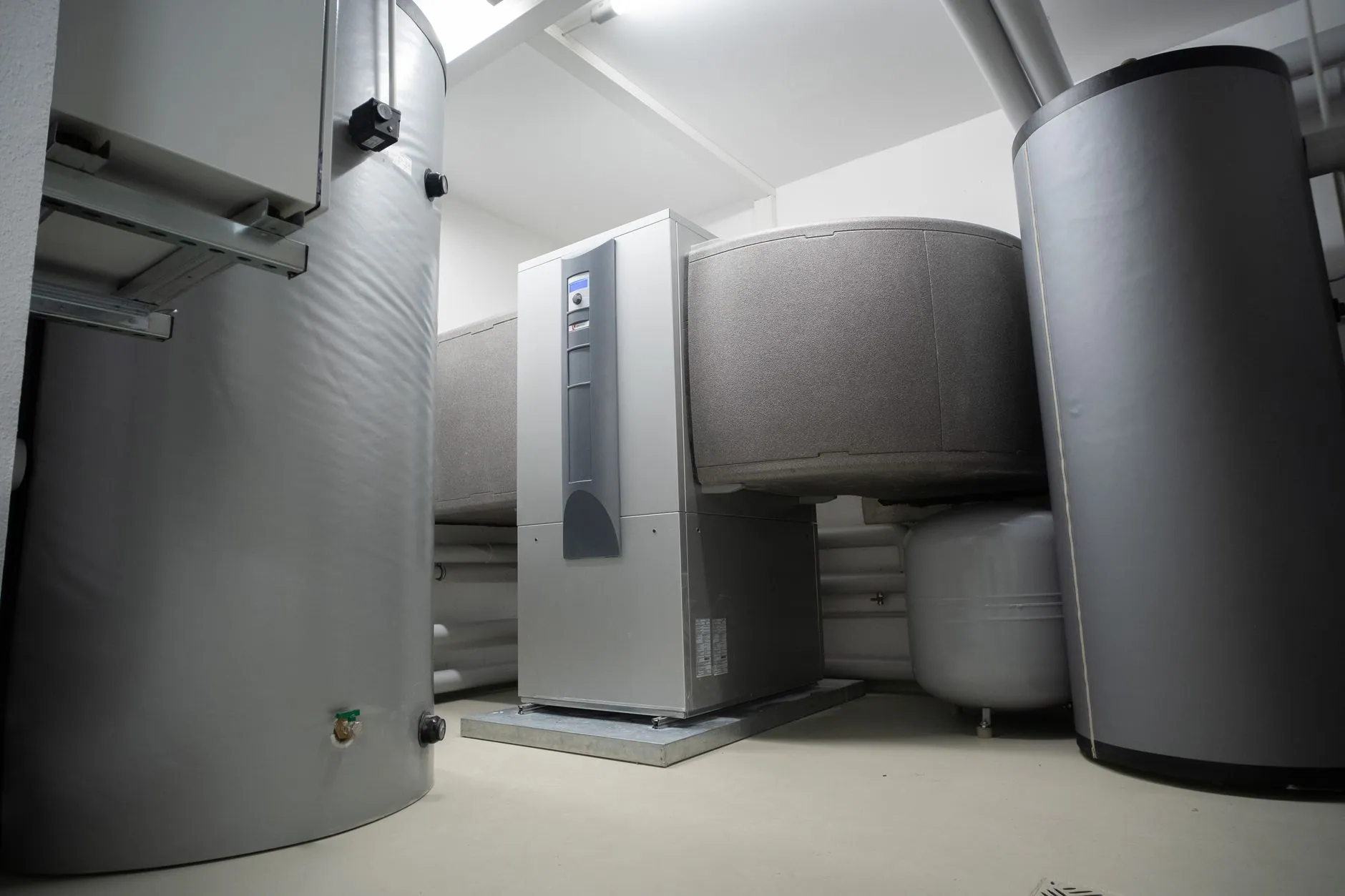
Typical commercial heat pumps project
- Typical scale
- 30 kW - 1 MW thermal
- Project value
- £30,000 - £750,000
- Typical payback
- 8 years
- Annual CO₂ saved
- 10-300 (vs gas) tonnes
Commercial heat pumps: what they are and why they matter for your business
Commercial heat pumps are the technology that decarbonises the heat your business burns gas or oil to produce. They move heat rather than create it, delivering space heating, hot water and some process heat at a fraction of the carbon of a boiler. For any business with a gas-heavy heat demand, a heat pump is the single most important step in cutting Scope 1 emissions, the on-site fossil-fuel emissions that solar panels and a green electricity tariff can never touch. If your carbon reporting has a large gas figure that will not move, this is the technology that moves it.
The economics are governed by one number: the coefficient of performance, or COP. A commercial heat pump running at a COP of 3 to 4 delivers 3 to 4 kWh of heat for every 1 kWh of electricity it consumes. That efficiency is what makes electrified heat viable against a gas boiler that burns a unit of fuel to make roughly a unit of heat. Run that heat pump on self-generated solar power rather than grid electricity, and the running cost falls further still. This is why we rarely recommend a heat pump in isolation: it is strongest as part of a wider renewable stack, sized correctly and fed with clean power.
Heat is where most commercial decarbonisation plans stall, because it is harder and more capital-intensive than adding solar to a roof. It is also where the credible carbon reductions sit. We treat heat pumps as an engineering decision, not a product sale. That means an honest assessment of your building fabric, your heat load, your emitters and your flow temperatures before we quote, and a clear answer on whether now is the right time or whether you should upgrade the building first.
How commercial heat pumps work
A heat pump uses a refrigerant cycle, the same physics as a fridge run in reverse, to absorb low-grade heat from a source and upgrade it to a useful temperature for heating. It is powered by electricity, but it does not turn that electricity into heat directly. Instead it uses the electricity to move heat that already exists in the air or the ground, which is why the output is several times the electrical input.
There are two main types for a commercial building.
Commercial air source heat pumps
Commercial air source heat pumps (ASHPs) extract heat from the outside air. They are the most common choice for a business because they need no land, no drilling and less civil work, so the installed cost is lower and the project is simpler to plan. External units mount on the ground, a roof or a wall and connect to the building’s heating and hot-water system. Air source suits the majority of commercial buildings, from offices and retail to light industrial units, and remains the default starting point unless a site has a specific reason to look at ground source.
Commercial ground source heat pumps
Commercial ground source heat pumps (GSHPs) draw heat from the ground through boreholes or horizontal ground loops. The ground holds a stable temperature year-round, so a GSHP runs at a higher and more consistent COP than air source, particularly in cold weather when a business’s heat demand peaks. The trade-off is a much higher upfront cost and the need for land or drilling, plus a longer programme. Ground source earns its place on sites with available land, a steady constant heat load, and a long enough tenure to recover the borehole investment.
Both types replace gas and oil boilers for space heating and hot water, and higher-temperature units can serve some low-grade process heat. What they do not do well is very high-temperature industrial process heat, which usually needs a different route. We will say so plainly if your heat demand sits outside the sensible envelope for a heat pump.
Sizing and economics: the real numbers
A commercial heat pump project typically ranges from £30,000 to £750,000 and delivers 30 kW to 1 MW of thermal output. Where a scheme lands in that range is driven by the building’s heat load, the type of system, and whether emitters and controls need upgrading alongside it. Payback is usually 7 to 12 years. That is longer than commercial solar, which typically pays back in 5 to 8 years, because heat pumps address a harder problem, but the carbon it removes is carbon nothing cheaper can reach.
Two things move the payback in your favour, and we build both into every design.
First, size to a reduced demand. The worst heat-pump projects are oversized units bolted onto a leaky building to serve the same wasteful heat load a boiler was covering. The best projects follow the energy hierarchy: improve the fabric and controls first so the heat demand drops, then size a smaller, cheaper heat pump to that lower, well-managed load. A tighter building with the right flow temperatures lets the heat pump run at a higher COP all year, which is where the running-cost savings come from. Our energy management and efficiency work almost always comes before, or alongside, a heat pump for exactly this reason.
Second, run it on self-generated power. A heat pump is an electrical load, and its economics live or die on the price of that electricity. Paired with on-site commercial solar and, ideally, battery storage, a meaningful share of the heat is produced on power costing a few pence per kWh rather than grid electricity at 25 to 45p. That is the difference between a marginal business case and a strong one. We model the heat pump, the solar and the storage together, from your half-hourly consumption and metered gas data, so the payback we quote reflects how the systems actually interact rather than each in isolation. See our running cost and payback modelling for how we build these numbers.
To put the economics in context, a representative office retrofit we would model, replacing a gas boiler with a commercial air source heat pump sized to a fabric-improved building and run partly on new rooftop solar, brings Scope 1 heating emissions close to zero, lifts the EPC, and recovers roughly a quarter of the capex through capital allowances. We frame every project this way, as a modelled outcome from your data, never as an inflated headline number.
Funding and grants for commercial heat pumps
This is where a lot of businesses are misled, so we are precise about it. The Boiler Upgrade Scheme does cover a building you own and use for your business, and pays £7,500 towards an air or ground source heat pump - but it is capped at 45 kW thermal and one grant per property, so it cannot fund a system at the scale this page describes. A small owner-occupied premises can genuinely claim it; any company implying it will fund a commercial-scale project is wrong, and you should treat the rest of their advice with caution.
The genuine funding routes for a commercial heat pump are these:
- 100% Annual Investment Allowance. Heat pumps qualify as plant and machinery, so a profitable company can deduct the full capex from taxable profit, recovering roughly a quarter of the cost through tax. This is the primary lever for most privately owned businesses.
- Public Sector Decarbonisation Scheme (PSDS) (closed: no application window since Phase 4 ended in November 2024) and Salix. For public bodies, schools, NHS trusts, colleges and councils, this is the principal commercial heat-pump funding line, offering grant funding and interest-free loans, applied for centrally by the body.
- Industrial Energy Transformation Fund (IETF) - closed. The Industrial Energy Transformation Fund closed to new applications in July 2025 and, following the Spending Review, will not be extended. No successor fund is planned, so energy-intensive sites now fund process and heat decarbonisation through capital allowances, PPA funding or asset finance.
- Enhanced Capital Allowances (ECAs) where they apply to qualifying efficient equipment.
We keep the position on funding honest and current on our grants and funding page, and we model the effective net cost after the relief your business can actually claim, not a best-case figure you will never realise.
Compliance, planning and grid connection
Getting the compliance right early keeps a heat-pump project on schedule. The main considerations are these.
Certification and design standards. MCS certification covers commercial heat-pump systems up to 45 kW. Larger installations follow CIBSE and commercial design standards, with the system sized and specified by a qualified engineer to the building’s measured heat load. We size from data, not assumption, so the design is defensible.
F-gas regulations. Heat pumps contain refrigerant, so installation, servicing and eventual decommissioning fall under F-gas regulations. Refrigerant handling must be carried out by suitably qualified engineers, and the choice of refrigerant matters for long-term compliance. We factor this in at the design stage rather than leaving it as a surprise later.
Planning. Many heat-pump installations proceed without a planning application, but external units and, in particular, ground-source boreholes may need planning consent depending on the site, its location and any listed or conservation-area status. We check the position for your site before design work starts so there are no late surprises.
Grid connection. A heat pump is a new electrical load, and a large one can require a supply upgrade or a G99 application to the Distribution Network Operator. Load management, or running the heat pump on solar and battery, often avoids or reduces a costly reinforcement. Connection timescales run from a few weeks for small changes to many months for large ones, so we get any application in early. Where the site is also adding EV charging, we plan the combined load once rather than twice.
For sites where the specialist depth of a heat-pump-only build is needed, we work alongside our sister specialists at commercial heat pump installers, who focus exclusively on commercial heat-pump design and delivery.
When a commercial heat pump does, and does not, suit a business
We are technology-neutral, so here is the honest view.
A heat pump makes strong sense when: your business has a significant gas or oil heat load you need to decarbonise; you can improve the building fabric and controls so the system is sized to a lower demand; your emitters can run at lower flow temperatures, or can be upgraded to; you have or are adding on-site solar to power it cheaply; and you have a Scope 1 carbon target that a green tariff cannot satisfy.
A heat pump is the wrong first move, or should wait, when: your building is leaky and uninsulated, in which case fix the fabric first or you will pay to generate heat you are wasting; your heat demand is very high-temperature industrial process heat outside a heat pump’s sensible range; your emitters are undersized and cannot be upgraded within budget; or you have cheaper, faster wins on the table, such as efficiency measures and solar, that should be sequenced first to keep the whole programme cash-positive.
An honest specialist always has an answer to “what would you not install on our site, and why”. If a heat pump does not stack up for your building today, we will tell you, and we will tell you what to do instead. That independence is the point: our advice is not steered by the one product we happen to sell.
How a heat pump fits the wider renewable stack
A commercial heat pump rarely works best on its own. It sits inside a sequenced renewable strategy, and the order matters.
Measure and reduce first, through an energy audit and efficiency programme, so the heat demand is as low as it can sensibly be. Generate next, with commercial solar sized to a share of your consumption, so there is cheap on-site power to run the heat pump. Store and shift with battery storage, lifting the share of solar the heat pump can actually use across evenings and cold spells. Electrify heat with the heat pump and transport with EV charging, ideally on that self-generated power. And fund the whole roadmap through capital allowances, grants, or, where a large project needs zero capex, a power purchase agreement. On sites with the right land or a constant simultaneous heat-and-power load, on-site wind or combined heat and power can round out the mix, though we assess honestly whether they beat the simpler options.
Designed as one integrated system rather than four separate installs, the parts reinforce each other: the solar cheapens the heat, the battery widens the window in which it runs on clean power, and the efficiency work shrinks the whole demand the heat pump has to meet.
How we work
We start with your data and your building, not a product. We pull your metered gas and half-hourly electricity figures, survey the fabric, the emitters and the plant, and model whether a commercial heat pump stacks up now, later, or alongside other measures. You get an independent, costed assessment that sequences heat within your wider renewable roadmap, with the payback, the carbon saving and the effective net cost after tax relief and any grant set out clearly. The work should be MCS-certified where applicable, engineered to CIBSE standards where larger, and covered by an insurance-backed warranty. If a heat pump is not the right first step for your site, we will say so. To get an honest assessment of whether commercial heat pumps suit your business, request a quote and free assessment or read the frequently asked questions first.
Get a free commercial heat pumps assessment
Commercial Heat Pumps: common questions
Is there a Boiler Upgrade Scheme grant for commercial heat pumps?
Rarely at commercial scale. The Boiler Upgrade Scheme does cover a building you own and use for your business, paying £7,500 towards an air or ground source heat pump, but it is capped at 45 kW thermal, so it cannot fund the systems this page describes. For a larger system, the funding routes are 100% Annual Investment Allowance on the capex, and the Public Sector Decarbonisation Scheme (closed: no application window since Phase 4 ended in November 2024) for public bodies. We model the effective net cost after tax relief before you commit.
How much do commercial heat pumps cost and what is the payback?
A commercial heat pump project typically runs from £30,000 to £750,000 depending on the heat load, ranging from a single small building to a large multi-building site. Payback is usually 7 to 12 years, faster where the system is sized to a reduced demand and run on self-generated solar. We size every system from your metered gas and heat data, not a rule of thumb, so the payback figure is defensible to the board.
What is the difference between air source and ground source for a business?
Commercial air source heat pumps sit outside and draw heat from the air, suit most buildings, and cost less to install. Commercial ground source heat pumps draw heat from boreholes or ground loops, need land or drilling, cost more upfront, but run at a higher, steadier efficiency and suit sites with a constant year-round load. We assess both honestly against your site and load profile rather than defaulting to one.
Will a heat pump work with our existing heating system?
It depends on the emitters and flow temperatures. Heat pumps run most efficiently at lower flow temperatures than a gas boiler, so oversized radiators, underfloor heating or fan coils work best. A fabric and controls upgrade first lowers the heat demand and lets the system run efficiently. We survey the building, model the flow temperatures, and tell you honestly if the emitters need upgrading before a heat pump makes sense.